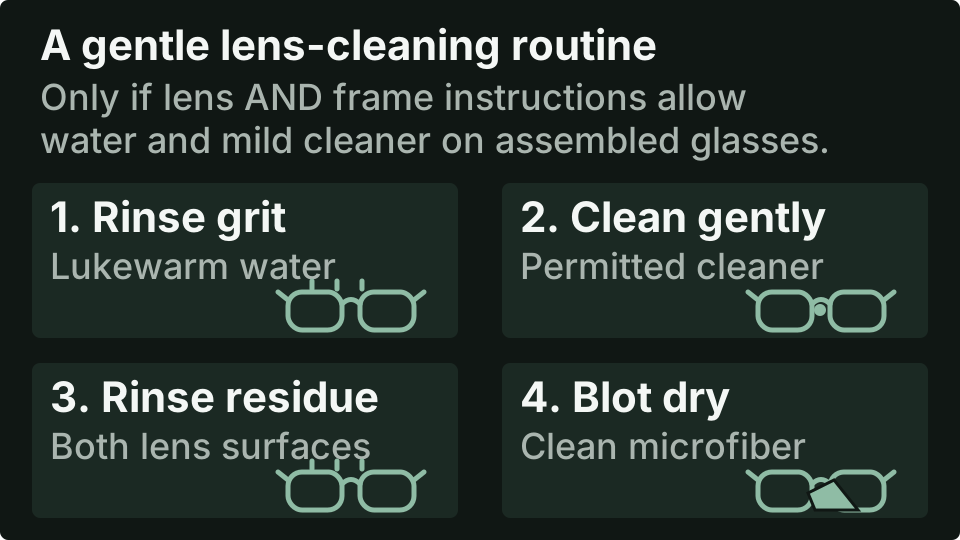
To clean eyeglasses properly, remove loose grit before wiping, gently clean both lens surfaces with a suitable cleaner, rinse away residue and blot dry with a clean microfiber lens cloth. Rubbing harder is rarely the useful next step when a mark remains. HOYA’s lens-care guide supports gentle washing, rinsing and contact drying.
First, check the instructions for your final lenses and coatings and your frame, finish and attachments. The water-and-mild-cleaner routine below applies only when those instructions permit it on the assembled glasses. Specialty coatings, including anti-fog treatments, and electronic or decorated eyewear need their own care directions. If compatibility is unclear, ask your optician before choosing a method. For example, Oakley’s Iridium eyewear lens guidance limits cleaning to its specified bag or kit; a general cleaning recipe should not override it.
Gather a few suitable supplies
Have everything ready before starting:
- Clean hands, washed and rinsed to remove soap residue.
- Lukewarm running water.
- The mild cleaner allowed by your care instructions.
- A clean microfiber cloth intended for eyeglass lenses.
Cleaner formulation matters. HOYA describes mild, lotion-free liquid soap, while ZEISS’s home-cleaning guidance specifies pH-neutral washing-up liquid. Neither description means that every bottle beside the kitchen sink is suitable. Choose the product your eyewear instructions allow rather than assuming that a familiar household brand qualifies.
Clean compatible eyeglass lenses in four steps
This sequence covers the lens surfaces. Frame and nose-pad care follow separately below.
1. Rinse away loose dirt
Wash and rinse your hands first. Then gently rinse the lenses with lukewarm running water before touching their surfaces with your fingers or cloth. Give loose particles a chance to wash away instead of dragging them across the lens.
Avoid starting with a dry polish, even when the glasses only look dusty. HOYA explains that rubbing particles against a lens can scratch it, particularly with an unsuitable cloth or paper tissue. The rinse-first sequence combines that caution with the manufacturers’ washing guidance. Source: HOYA.
2. Clean both lens surfaces gently
Using clean fingertips, gently spread a small amount of the suitable mild cleaner over the front and back of each lens. Keep the contact light; this step removes surface grime rather than buffs the lens. Avoid extending this soap routine to nose pads, hinges or decorative pieces.
ZEISS describes lathering a drop of pH-neutral washing-up liquid between the fingers before applying it to the lenses. Follow your cleaner’s directions for quantity rather than adding more whenever a smear is visible. Source: ZEISS.
3. Rinse off the residue
Gently rinse both sides of the lenses under lukewarm running water to remove the cleaner. Take care to finish this step before drying; remaining soap gives you another film to wipe around. This is a brief rinse, with no soaking or home ultrasonic-cleaning step. ZEISS’s lens routine includes rinsing after cleaning.
4. Blot dry and inspect
Touch the clean microfiber cloth gently to the lens surfaces to absorb droplets. Avoid squeezing the glasses inside the cloth or polishing vigorously. HOYA describes drying by allowing the cloth to contact the water drops without rubbing. Source: HOYA.
Look at both lenses after drying. If a smear remains, check the cloth and rinse quality before repeating the same wiping motion. A mark that survives gentle cleaning needs a different decision, covered below.
Give the frame and nose pads separate care
Use the frame manufacturer’s directions for the frame, finish and nose pads. A cleaner suitable for a lens does not by itself establish suitability for the surrounding parts. As a limited example, Ray-Ban’s FAQ for customized and engraved frames describes gentle cleaning with microfiber and lens-cleaning solution while avoiding abrasives and harsh chemicals. That advice belongs to that frame context.
Keep the glasses steady without pulling one temple against the other or using a hinge as a lever. Do not force an adjustment to reach dirt. If grime is trapped in a joint, a pad is loose or a component moves unexpectedly, ask an optician about cleaning and service instead of prying it apart. Oakley’s frame-accessory guidance also distinguishes its available accessory kits from other parts that users should not remove.
Our guide to eyeglass frame parts can help you name the area when requesting help. The nose-pad guide explains attachment types; it is not a removal procedure.
Clean glasses away from home
Carry a purpose-designed lens wipe or spray that is suitable for your glasses, and use it according to its label. A cleaning wipe is a specific product, so check both the wipe’s instructions and your eyewear care directions. Do not substitute a household surface-disinfecting wipe.
ZEISS discusses moist lens wipes and spray with microfiber for cleaning away from a sink. A shirt sleeve, scarf or tissue is a poor substitute: trapped particles can scratch lenses. If the glasses are gritty and you have no suitable way to remove the grit, wait until you can clean them properly rather than dry-rubbing them.
Keep the cleaning cloth clean
A cloth can become part of the smear problem. HOYA warns that fabric-softener residue can leave a cloudy film; ZEISS likewise advises laundering microfiber without softener. Wash the cloth according to its own instructions, rinse it thoroughly and let it dry before storing it cleanly. HOYA’s cloth guidance includes hand-washing and air-drying options.
Check the cloth before each use. If it is dirty, use another clean lens cloth while you wash it. Keep your lens cloth separate from cloths used for household cleaning.
Common mistakes to avoid
Paper towels, tissues and clothing can bring abrasive particles into contact with lenses. Choose clean lens microfiber instead. Hot water and excessive heat also deserve caution: ZEISS explains that heat can damage lens coatings. Do not use hotter water to make cleaning seem more thorough.
Skip household glass cleaner and improvised chemical mixtures; their suitability for your complete glasses has not been established by a lens-cleaning guide. Likewise, toothpaste, baking soda and abrasive polishing are not solutions for damaged lenses. ZEISS states that scratches in plastic or glass lenses cannot be removed. Cleaning is for removable grime, not scratch repair.
Still smeared, scratched or cloudy?
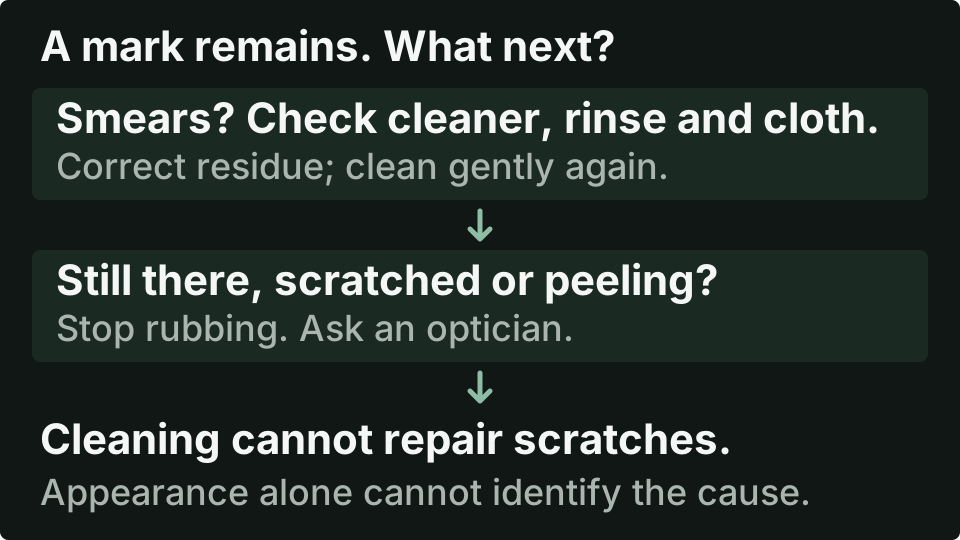
Start with the simple checks: did you use the correct cleaner, rinse it away and dry with a genuinely clean cloth? If you find a likely residue problem, correct it and gently clean again. Stop if the mark persists rather than increasing pressure or trying stronger chemicals.
Visible scratches, peeling or a cloudy area that remains after suitable cleaning are reasons to ask an optician to inspect the lenses. Appearance alone cannot tell you whether you are seeing residue, a scratch or coating damage. ZEISS’s care guide explains why scratches require a different response from dirt. Avoid home polishing attempts.
Frequently asked questions
Can I use dish soap on my glasses?
Only if the formulation fits your eyewear instructions. Mild, lotion-free or pH-neutral descriptions in lens-maker guidance are not permission to use every dishwashing product. Ask your optician to identify an appropriate cleaner if the instructions are unclear.
Can I use alcohol wipes?
Check the exact wipe and the glasses’ care instructions. The word “alcohol” alone is not a sufficient compatibility test, and neither a universal ban nor universal permission is useful. Use a specified lens-care product rather than substituting a general-purpose alcohol wipe.
How often should I clean the glasses and cloth?
Clean when dirt or smears need removing, following the supplied directions. Inspect the cloth before use and wash it when dirty.
Can cleaning remove scratches?
No. Gentle cleaning can remove surface grime, but it cannot restore a scratched lens. Ask an optician to assess persistent damage rather than buying a polishing remedy.
Get care instructions you can actually follow
If you are unsure which cleaner to choose, ask your optician for directions covering both the fitted lenses and the frame. Bring the glasses and the cleaning product you intend to use so the question is specific.
For optical retailers preparing customer leaflets, our private-label frame-care checklist covers agreeing and documenting those instructions before an order ships.