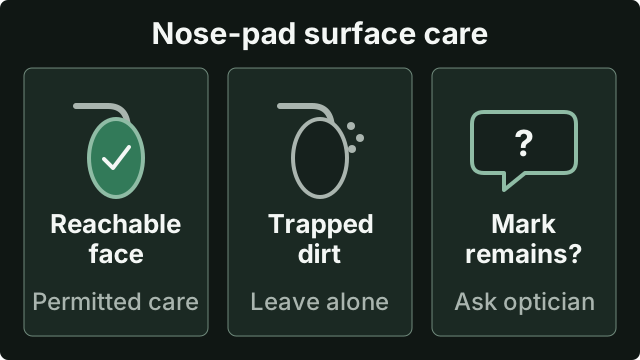
Clean eyeglass nose pads only on the nose-contact surfaces you can reach without moving or removing them. Use the method allowed for your glasses, and leave dirt trapped behind a pad or in its mount for an optician to assess.
Before using the water-and-cleaner method below, check that the care instructions for your final lenses and coatings, frame, pads, finishes and attachments all permit it on the assembled glasses. If the instructions are unclear, ask the dispensing optician first. A material name such as titanium or silicone does not establish which cleaner the assembled glasses can tolerate.
Clean the accessible nose-pad surfaces
Have running lukewarm water, the permitted pH-neutral cleaner and a clean microfiber cloth ready. Hold the frame on the side you are cleaning and keep the assembly steady.
ZEISS’s general frame-care guidance recommends lukewarm running water, a small amount of pH-neutral washing-up liquid and holding the side being cleaned; it also includes nose pads among the areas to clean. In its own reading-glasses care guide, ReadingGlasses describes rinsing, microfiber and cleaner. The steps here bring that guidance together for reachable pad surfaces; neither source confirms compatibility for your particular glasses.
- Rinse the exposed contact area. Keep the pad attached and work only on the face that rests against your nose.
- Gently clean that reachable surface. Use water, a small amount of the permitted cleaner and clean microfiber. Keep the cloth on the exposed surface rather than pushing it around the pad’s edges into the mount.
- Rinse away the cleaner and dry gently. Use clean microfiber on the reachable surface. Do not force the cloth behind the pad or into its connection.
- Look at the surface after drying. If dirt or color remains, stop rather than pressing harder or trying a stronger chemical.
For the separate task of cleaning the lenses, follow the lens-care guide and your lens provider’s directions.
Leave trapped dirt and attachments alone
The surface covered here is the nose-contact face you can reach without moving, removing or bending anything. Dirt underneath the pad or inside a joint or mount is outside this method. Leave the assembly intact; do not pry at it or push a brush, swab or cloth into the gap.
Use these observations to decide when to stop:
- Is the dirt behind the pad or inside its connection? Leave it there for assessment instead of trying to reach deeper.
- Is a pad loose, or does a component move unexpectedly? Stop cleaning and ask an optician to check it.
- Do you see damage or a change in the finish? Stop and point out the affected area to the optician.
If you need help describing the location, identify the pad and its supporting arm. Our guide to nose-pad attachment types explains the connections; identifying one does not mean you should undo it for cleaning.
If the pads still look discolored, ask for assessment
If a mark remains, note where you see it: on the contact face, along a visible edge or around the mount. Describe the color and location without trying to identify the cause from appearance alone.
Persistent dirt or discoloration is a reason to stop increasing pressure or changing cleaners. It does not by itself tell you that a pad needs replacement. An optician can assess what cleaning or service, if any, is appropriate for the actual assembly.
Bring your glasses and the cleaner you intend to use to the dispensing optician. Show the remaining mark and mention any looseness, unexpected movement or visible change. Ask which care method applies to your glasses and whether the pad or its connection needs attention.