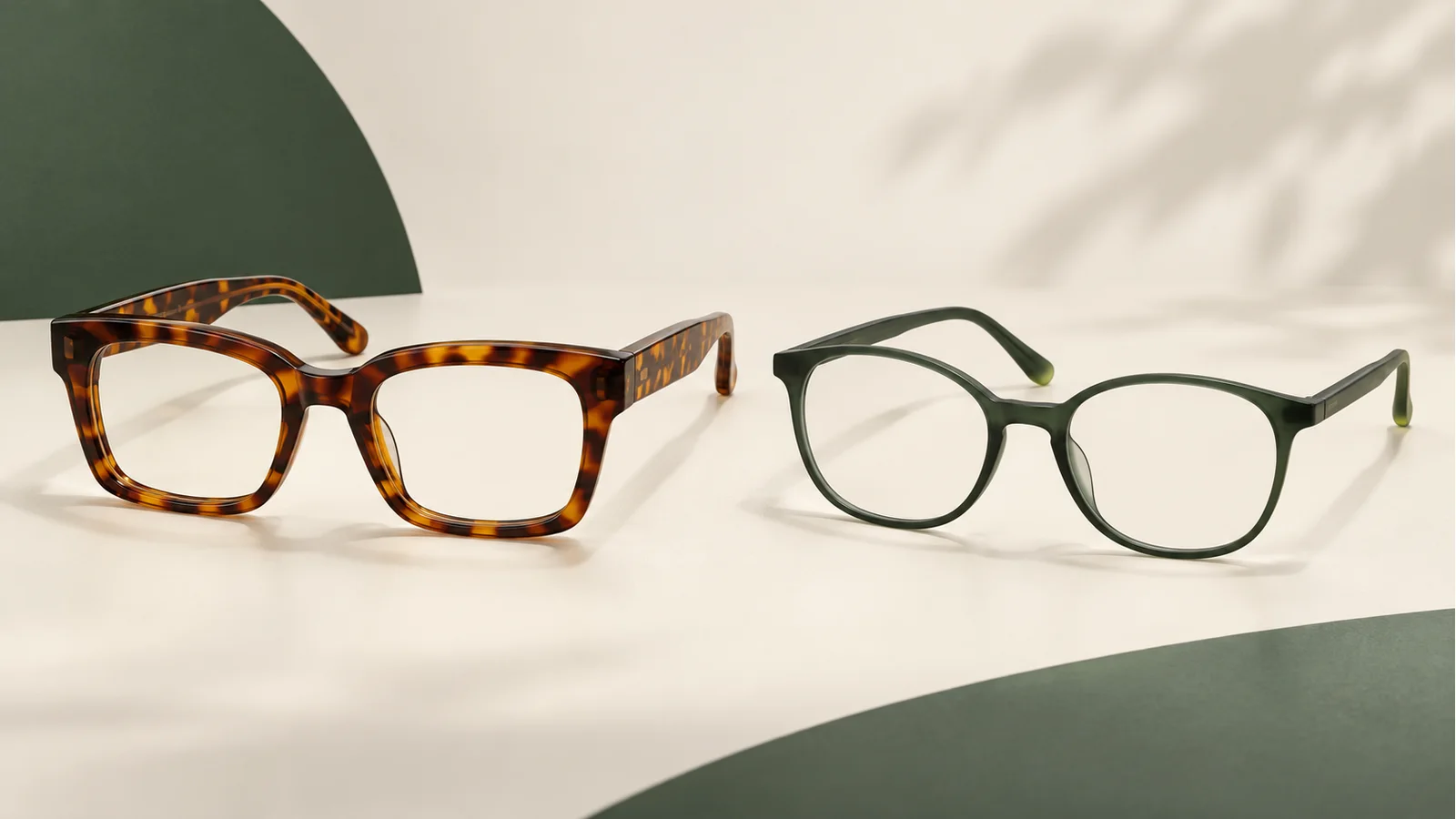
Compare acetate and TR90 glasses frames by the specific designs you plan to buy. Sheet cellulose acetate can make color and pattern central to a frame design. TR90 is used as a label for polyamide-based eyewear offers, often associated with molded components. Neither label tells a buyer the full frame construction, current availability or finished-product performance.
If the basic terms are unfamiliar, read what acetate frames are and what a TR90 label means first. This article focuses on selecting a route for a wholesale or private-label brief.
What are you actually comparing?
Mazzucchelli’s sheet-material guide documents cellulose acetate formulations and multiple ways to create decorative sheets. EMS-GRIVORY identifies Grilamid TR 90 as a transparent polyamide for optical applications. These references establish material categories and producer-described uses. They do not prove the resin source or construction of a frame from any particular eyewear supplier.
| Question | Sheet-acetate frame offer | TR90-labeled frame offer |
|---|---|---|
| Material identity | Request cellulose acetate formulation or material reference for selected parts. | Request the exact resin or grade claim for selected parts. |
| Visual direction | Color, translucency and pattern within the sheet may define the design. | Ask which colors and surface effects are actually available for the selected model. |
| Production brief | Specify sheet reference, front and temple profile, and finishing. | Specify the model, molded components and any tooling or appearance changes. |
| Mixed materials | Map cores, hinges, screws and any metal parts. | Map hinges, temples, trims and any non-TR90 parts. |
| Buying check | Approve the physical pattern, profile and assembled fit. | Approve the physical material claim, construction and assembled fit. |
The table describes what to request, not a universal comparison of strength, price, weight or environmental impact. For those outcomes, a supplier must quote and test the actual design.
Appearance and repeatability
An acetate buyer may choose a sheet for a specific pattern or depth of color. A reference photo may not show how a pattern is distributed across production pieces, so ask what variation is acceptable and whether approval is by sheet, sample frame or both. Do not assume every catalog color remains available indefinitely.
For a TR90-labeled offer, ask for current color options for the selected model and whether a proposed new color can be made on the same order terms. A marketing color name does not specify pigment, surface appearance or tolerances. Review physical samples when color matching matters.
Both materials can be used in frames with branding. The practical question is where the logo sits, how it is applied, and whether the proposed method works on the chosen model and finish. Confirm those items in a sample, not only in a quote.
Weight, adjustment and durability need product evidence
Do not assume all TR90 frames are lighter than all acetate frames or that one material is always more flexible. Frame size, rim profile, temple geometry, hardware and lenses affect the finished result. Compare samples of the intended designs on the same measurement basis.
Adjustment methods can differ by model and construction. Ask the supplier how the approved sample should be fitted and what movements are acceptable. If the product must meet a defined durability or market requirement, name the requirement and request model-level evidence. A resin-maker technical sheet is not a finished-eyewear test report.
Likewise, “hypoallergenic,” “recycled” and similar claims need specific support. Do not carry a raw-material claim over to an assembled frame without checking every relevant component and the scope of the supplier’s documentation.
Stock purchase, private label or new design?
When buying an existing style, start with current model, colors, sizes and quantity conditions. Private label adds logo and sometimes packaging decisions. A new front shape or temple structure is a different development request even if the requested material is familiar. Ask which changes can use an existing model and which require a new sample or tooling review.
The question “Which is cheaper?” cannot be answered from material names alone. Send the same target size, design intent, quantity split, branding and packaging to each supplier. Our quote-comparison guide helps separate unit, sample and tooling terms.
Our published acetate models provide a catalog starting point. We do not present a published TR90 product line here. If you have a specific TR90 reference or mixed-material idea, send it for feasibility review rather than assuming it is currently available.
If you need an acetate size reference for that brief, GG6013F lists a 48 mm lens width, 23 mm bridge and 150 mm temples. Those catalog measurements provide a starting point for sample review, not evidence that acetate will outperform TR90.
Frequently asked questions
Are acetate and TR90 interchangeable because both are plastics?
No. They refer to different material categories and may involve different production and design choices. Ask for the selected model’s component specification and a physical sample.
Does a TR90 listing prove the seller uses Grilamid TR 90?
No. A catalog label is not evidence of the producer or exact grade. Ask for documentation connecting the material claim to the quoted model if the distinction matters to your purchase.
Which should a wholesale buyer choose first?
Choose the design brief first: intended appearance, model or reference, size, quantity and required claims. Then compare actual samples and quotations. A broad material preference is a useful starting point, but not an order specification.