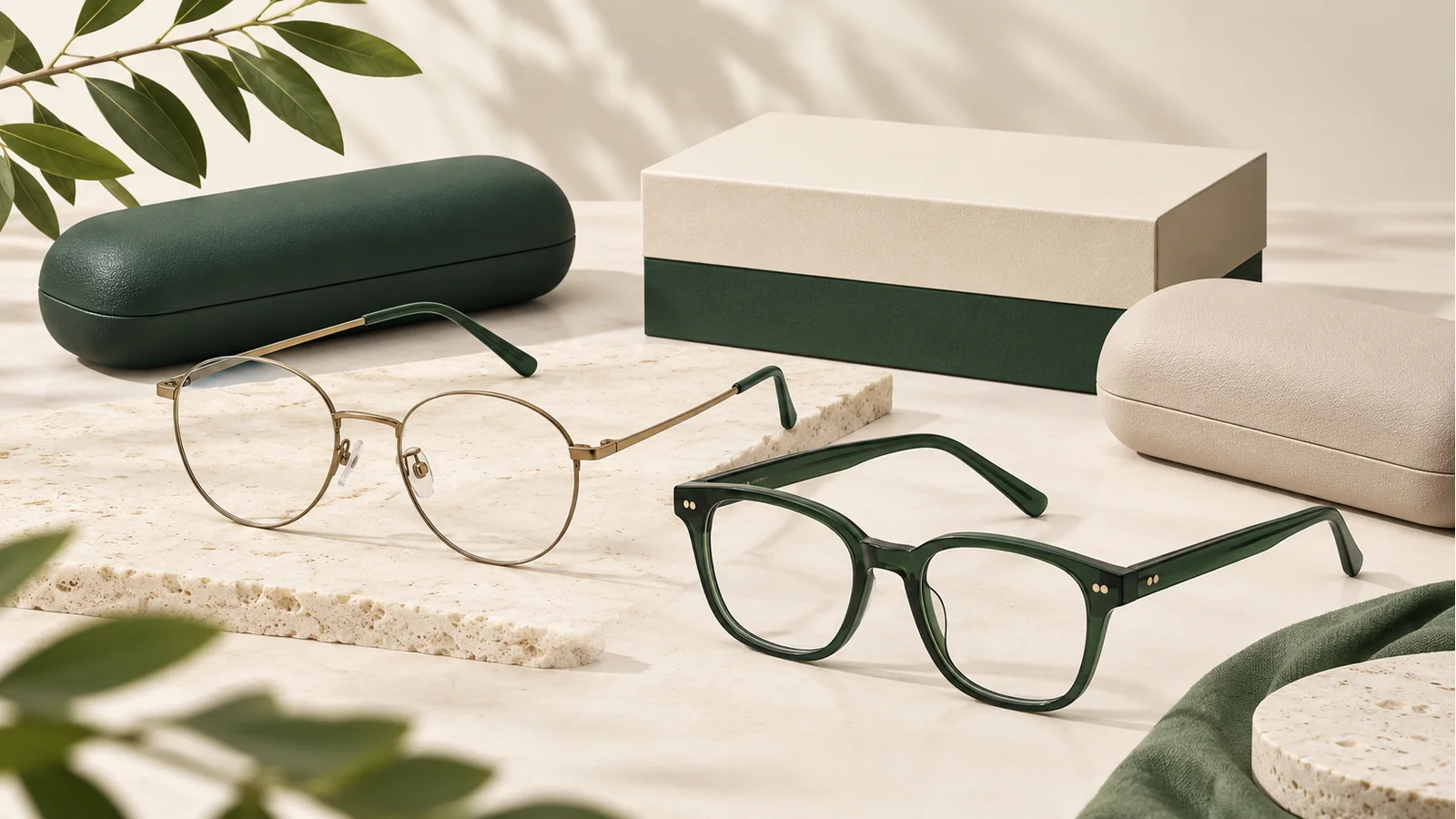
For a first private-label eyewear order, choose a frame that already meets your requirements. Then ask for separate quotes for the logo and packaging. Consider new colors or structural changes only when they solve a clear gap in the range you want to sell.
That is a purchasing sequence, not a promise that one branding method is always cheapest. The useful comparison is the total cost of your actual model, quantity and customization—not a supplier’s starting price.
This guide covers optical frames for retailers, wholesalers and emerging eyewear brands. For the wider buying process, start with our affordable wholesale eyeglass frame guide.
Choose the frame before choosing the logo
A branded frame still needs to fit your intended customer and product range. Specify the dimensions, material and construction you need, then review suitable existing models. Do not accept the wrong size simply because branding is included.
Ask which parts of the quoted model will stay unchanged. Record the model number, size, color reference and sample version. If you need a different bridge, temple or lens shape, identify that request separately rather than describing the whole order as “just adding a logo.”
Also confirm whether the selected frames are finished stock or require production. Private label describes the branding arrangement; it does not establish availability. Our stock-versus-made-to-order guide explains what to ask.
Set a first-order customization sequence
The sequence below is our buying recommendation, not a universal cost ranking. Ask the supplier to quote each addition against the same base frame so you can see what it changes.
| Decision | First-order approach | Confirm in the quote |
|---|---|---|
| Frame specification | Select an existing model that meets the brief | Exact version, sample and production status |
| Logo | Choose one useful location before adding more | Method, dimensions, setup and unit charges |
| Packaging | Price a suitable standard option alongside branding | Protection, quantities and packed dimensions |
| Colors and structure | Add changes only where the existing range falls short | New samples, minimums and approval steps |
Specify where the logo will remain
“Logo included” is not a complete specification. Ask whether the mark goes on the frame, a demonstration lens, the case or a removable label. These placements serve different purposes.
For example, Opticians Club’s private-label page distinguishes demo-lens branding from an option that also brands the frame. This is an example of that supplier’s published options, not a statement about every factory’s methods or terms.
A logo on a demonstration lens will not remain on the frame when that lens is replaced. If your goal is branding on the finished frame, specify a frame location and approve it on a sample. Packaging branding alone does not answer the same requirement.
Send your logo artwork and ask the supplier to confirm:
- Location and dimensions, with a marked layout showing orientation.
- The proposed marking method for the selected material and surface.
- Appearance on the actual frame color, not only on a white digital background.
- Sample, setup and per-unit charges, including any repeat-order charge.
Do not pick a process solely from its name. Ask to see the proposed result and agree how it will be checked. A digital proof can confirm placement; it cannot establish the appearance or durability of a physical marking.
Keep packaging useful before making it elaborate
Request a packaging option that fits and protects the frame, then price any branded case, cloth, insert or outer box separately. Compare the exact contents rather than two offers both labeled “custom packaging.”
Ask whether packaging has its own minimum quantity. If the case order is larger than the frame order, clarify who keeps the excess, how it is identified and whether storage or later shipping costs apply. Do not assume unused packaging will be held indefinitely.
Include packed dimensions and shipment weight in the freight request. A lower packaging unit price is not enough to judge the delivered total. Use actual quotes in your landed-cost comparison.
Separate color changes from changes to the frame
Before requesting a new color, review the available choices for the selected model. If none meets your brief, send a color reference and ask what sample and approval process applies. Do not rely on a screen image as the final color agreement.
A different frame shape, dimension or component needs its own review. Ask which parts change, whether new tooling or fixtures are needed, and how the supplier will demonstrate the revised specification. Do not assume an existing catalog model makes every modification tooling-free.
This is the manufacturing distinction that matters for the budget: keep unchanged work clearly separate from requested changes. It makes the quotation easier to compare without pretending to know the supplier’s internal costs. A necessary fit or construction requirement should not be dropped simply to preserve the cheapest branding package.
Request a base quote and itemized additions
Use a short request such as:
Please quote the selected model in the listed quantities by color. Show the base frame cost, logo sample and setup costs, recurring logo charges, packaging and shipping separately. Please identify any minimum quantity or production change caused by each option.
Ask what is included in the base price before adding the lines together; an included service should not be counted twice. Compare first-order and repeat-order terms separately, but do not assume a setup charge disappears on the next order.
Check whether minimums apply to the total order, each model, each color or the packaging. Our eyewear MOQ guide covers these different conditions. Avoid splitting a limited order across more variants than the agreed quantities support.
Approve one complete sample specification
Before authorizing the bulk order, bring the frame, branding and packaging decisions into one written specification. Identify the approved physical sample and record any differences between it and the production order.
Give the artwork an identifiable filename and revision, and link it to the layout or proof version, approved physical sample reference, frame model, material, finish and quotation version. We recommend keeping these references together so you and the supplier can identify the exact combination approved.
Check logo position, readability and finish, along with the frame itself. Review how it sits inside the packaging. Agree what evidence or checks you require for any performance claim; a visual review alone is not a durability test.
If something changes after approval:
- Identify the change, such as a revised artwork file, logo size or location, marking process, frame model, material or finish. Note which approved references it affects.
- Ask the supplier which proof, sample or other evidence and approval needs renewal, if any. Confirm whether quoted setup, sample or unit charges, minimum quantities or schedule conditions need reconsideration.
- Record the agreed revised references, required approvals and quotation conditions before authorizing the changed scope.
Use the frame sample checklist for the broader review. Keep the approved files and sample references available for repeat orders, and ask the supplier to flag substitutions before proceeding.
Discuss a first private-label order
Titanium Frames offers existing frame styles, logo/private-label options and OEM/ODM development for review. Browse the product range and custom eyewear options to define what you need.
Send a frame reference, quantity by color and logo requirement. Include your target budget and packaging needs if known. You do not need a complete engineering drawing to start the discussion; ask us to confirm suitable options and the scope of the quotation.
Frequently asked questions
What should I customize first on a limited budget?
Start with a suitable existing frame and a clearly specified branding location. Price packaging and further changes separately. This keeps the decision manageable; only the actual quotations can establish the lowest-cost acceptable option.
Does private label require a new frame design?
Not necessarily. A supplier may offer branding on an existing model. Confirm permission, available methods and order terms for that model rather than assuming every catalog frame qualifies.
Is a logo on the demo lens enough?
It may serve a display purpose, but it will be removed with the demonstration lens. If you want the frame itself branded, specify that separately.
Can I assume there are no tooling fees for an existing model?
No. Ask for confirmation based on the exact changes requested. Separate frame-development costs from logo setup, samples and packaging charges.