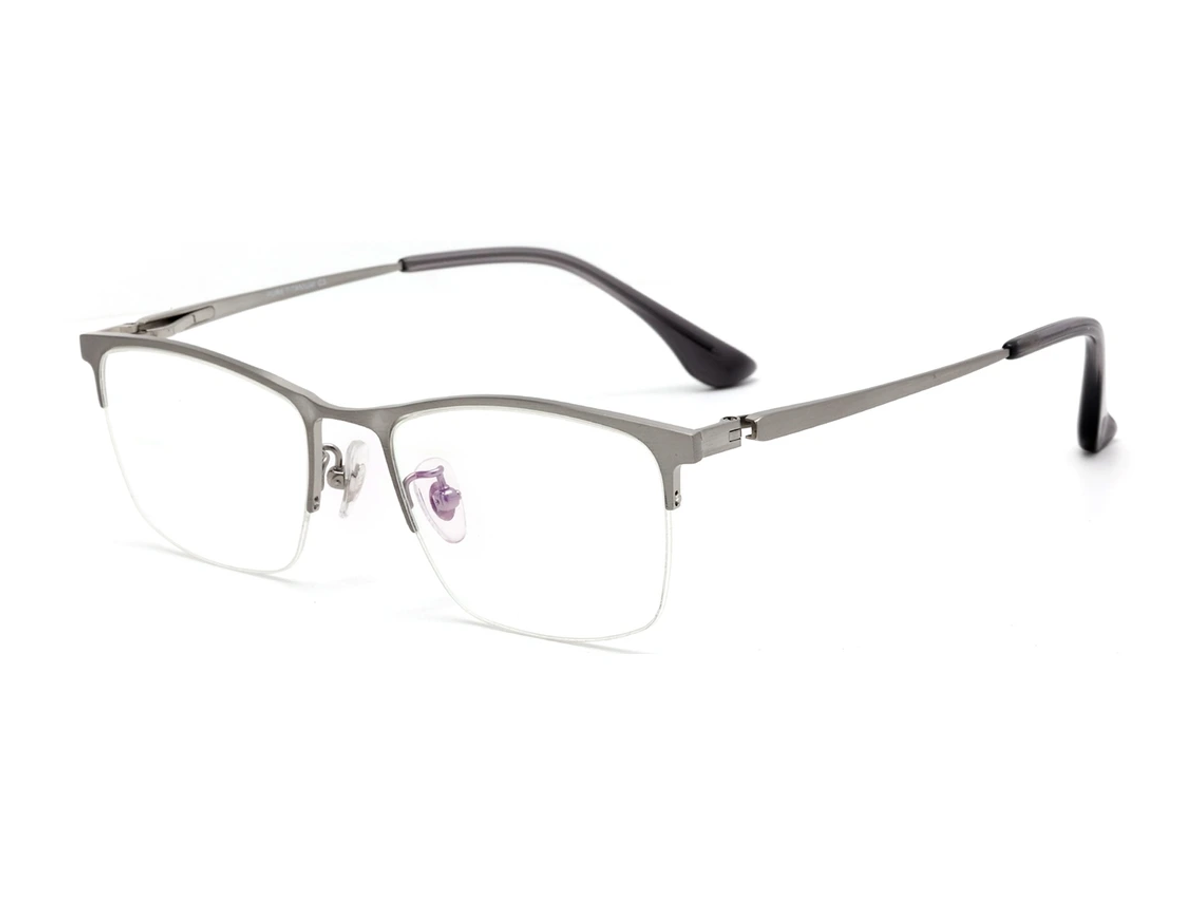
Titanium vs stainless steel eyeglass frames is a design and sourcing decision, not a universal quality ranking. Titanium offers a lower-density material direction. Stainless steel can also support light, slim frames. The finished result depends on the dimensions, components, joints and finish—not only the metal named in a catalog.
For wholesalers and private-label brands, compare two questions separately: which material supports the product brief, and which complete frame meets your sample and purchasing requirements?
This guide combines attributed public material information with a buyer-oriented comparison method. It is not a report of our own testing. The image above shows our catalog model CK0010; it is not a side-by-side material test.
If you first need to understand stainless steel as a material family, read our stainless steel frame buying guide before comparing two finished designs.
Titanium and stainless steel: a buying comparison
| Decision | Titanium direction | Stainless steel direction |
|---|---|---|
| Weight | Lower material density supports weight reduction; verify the assembled sample. | Thin construction can still produce a light frame; verify the assembled sample. |
| Specification | Request the grade or alloy and identify the components that use it. | Request the stainless grade and component map; “metal” is not specific enough. |
| Flex and durability | Confirm the required movement and sample performance, not just the titanium label. | Apply the same performance criteria; do not assume steel means rigid or unbreakable. |
| Surface and contact parts | Review the finished assembly, including hardware and coatings. | Review the finished assembly, including hardware and coatings. |
| Commercial decision | Quote the complete design, quantity and finish. | Quote the same scope before drawing a cost conclusion. |
The table is a purchasing framework, not a set of measured results. Neither column guarantees a finished-frame property.
Weight: compare samples on the same basis
The Royal Society of Chemistry’s titanium reference identifies titanium as much less dense than steel and lists its density at about 4.5 g/cm³. That is a material property, not a promise that any titanium frame will weigh a fixed percentage less.
A useful counterexample to “stainless means heavy” comes from MYKITA’s stainless steel material guide. The brand describes thin, lightweight constructions with a screwless hinge. This is the brand’s description of its own designs, not independent test evidence or a feature shared by every stainless frame.
Buyer analysis: separate material density from the amount of material in the design. A larger front, thicker temples or different hardware changes the comparison. Ask suppliers to state whether their quoted weight includes demo lenses, prescription lenses or neither.
For example, the source catalog for our CK0010 titanium frame lists 11.3 g without lenses. That figure describes one model. It does not establish the weight of another titanium design or an equivalent stainless frame.
For a sample comparison, record:
- frame size and rim construction;
- lens status when weighed;
- complete sample weight, not only the front;
- bridge and temple fit during the intended fitting review.
Do not choose by grams alone. Include fit and balance in the sample review rather than treating low weight as a comfort guarantee.
Material names need component-level detail
A quotation that says “titanium” leaves the alloy and the scope of that description open. Ask which parts use the specified material: front, bridge, temples, hinges, screws and nose-pad hardware. Keep pure titanium, beta titanium and other alloy descriptions distinct until the supplier provides the actual specification.
Stainless steel is also a family, not a single recipe. Outokumpu’s stainless steel overview distinguishes several groups and explains that composition and processing affect properties. Its Core range includes nickel-containing 304/4301 as well as grades described as nickel-free. Those industrial grade examples are not recommendations for a particular eyewear design.
The practical request is the same for both materials: name the grade, name the component and identify the supporting material record. Do not turn a front-material declaration into a claim about every part of the frame.
Flexibility, joints and finish require separate review
Define movement instead of asking for “stronger”
“Strong,” “flexible” and “durable” are not interchangeable acceptance criteria. Write down what needs to move, what must retain its shape and how the assembled sample will be evaluated.
For a temple, that might mean agreeing on the movement to assess and the acceptable condition afterward. For a hinge, identify the opening behavior and the inspection method. Ask the supplier to propose an appropriate test plan rather than inventing a universal cycle count.
This is a specification method, not a claim that one material passes tests the other cannot.
Review a material change as a design change
TWI’s guidance on welding titanium emphasizes cleanliness and protection of the hot weld region with inert gas to avoid contamination and embrittlement.
Manufacturing takeaway: a material substitution should trigger review of the joining approach, not just a revised line on the quote. Ask whether the proposed change affects joint locations, dimensions, sample development or inspection. The TWI reference is general joining guidance; it does not document our equipment or a particular frame’s production process.
Likewise, a brand’s proprietary hinge is a reference for understanding construction—not a design to copy or a capability to assume your supplier offers.
Check the finished surface, not only the base metal
RSC documents titanium’s corrosion resistance. Outokumpu explains that stainless grade selection must account for the exposure environment. Neither reference proves how a particular coated, assembled eyeglass frame will perform.
Ask for a finish sample and an agreed evaluation plan covering the complete assembly. Include joints, contact parts and coating appearance in the review. Do not describe either option as immune to corrosion or promise a universal service life.
If a product claim concerns nickel, request evidence for the claim’s exact scope. A material name or a nickel-containing alloy specification alone does not establish the finished product’s nickel release. Confirm the required assessment with the responsible testing provider; this guide makes no allergy-safety or compliance guarantee.
Cost: compare quotations, not material stereotypes
A label cannot tell you the price difference between two finished frames. Request paired quotations with the same intended size, styling, quantity split, branding, packaging and delivery scope. Ask the supplier to identify design changes needed for each option.
Separate the unit price from sample, tooling, testing and packaging charges. If one proposal uses an existing style and the other requires new development, you are comparing more than materials.
Our eyewear quotation checklist provides a fuller way to compare those commercial terms. No fixed price premium, savings percentage or material-specific MOQ is assumed here.
Which option should go into your OEM brief?
Use these as decision prompts rather than automatic selection rules:
- A titanium-led collection: start with a documented titanium specification, a weight target and a representative sample. Review our titanium frame category for current product references.
- A slim metal design without a fixed material requirement: ask suppliers to evaluate titanium and stainless proposals against the same design and sample criteria. Confirm availability and feasibility; a broad metal category is not proof of a specific stainless grade offering.
- A price-led wholesale program: compare available models and complete quotations first. Keep any changes to material claims, construction and finish visible when narrowing the options.
Before approving the chosen direction, keep one record containing the drawing revision, component materials, sample identification, finish reference, weight basis and agreed checks. If the supplier changes a material later, review the affected requirements before accepting the substitution.
Frequently asked questions
Are titanium frames always lighter than stainless steel frames?
No. Titanium’s lower density is relevant, but finished weight also depends on geometry and components. Compare actual samples with the same lens status rather than applying a fixed percentage.
Is stainless steel a low-quality frame material?
The material name does not establish a quality tier. The documented stainless eyewear example above shows a deliberate lightweight design approach. Your own purchase still needs a specified grade, approved sample and agreed checks.
Can the same design be made in both materials?
Ask for a feasibility review. Do not assume the same dimensions, joint design and production route can be transferred unchanged. Record any proposed differences before comparing samples and prices.
Does titanium mean every component is nickel-free?
No such conclusion follows from the label alone. Request a component list and evidence for the exact claim you intend to make. Do not infer whole-frame properties from the front material.
What should I send before requesting a quotation?
Send a reference frame, photo or drawing, known dimensions, quantity, target market and finish direction. State whether the material is mandatory or open for review. You do not need to invent a technical specification before asking which information is missing.
Discuss the design before locking the material
Developing a titanium eyewear collection or comparing a metal-frame alternative? Send your reference and target requirements for review. Include your quantity and target price if available, and identify which design features must stay unchanged.
The custom eyewear development process explains how a reference or product idea can become a reviewable brief. Specific materials, sample options and commercial terms remain subject to project confirmation.