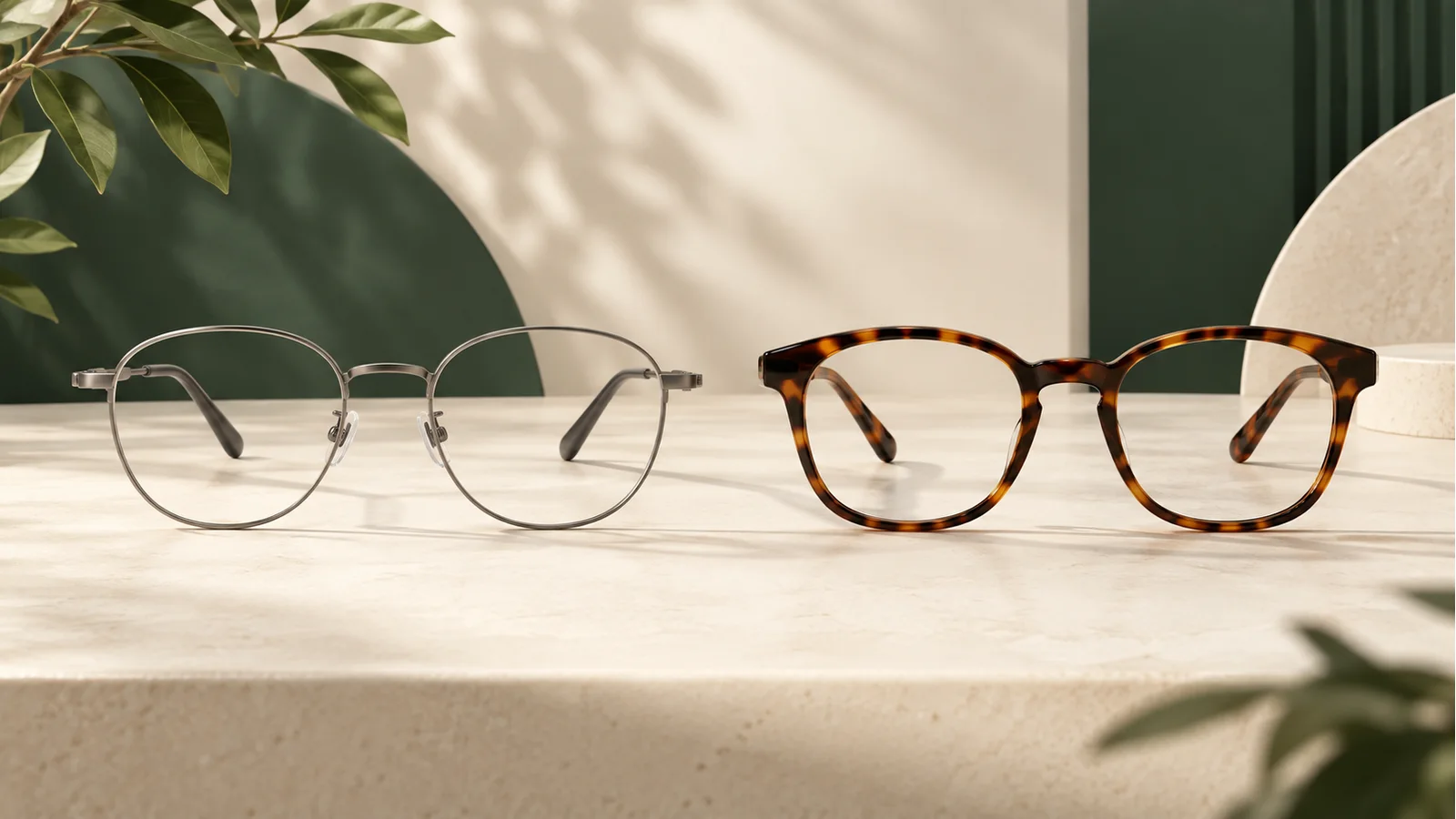
Compare titanium and acetate glasses frames as complete designs, not just material labels. A titanium front can be delicate or broad; an acetate frame can use different sheet thicknesses, patterns and hardware. Review the intended design and a complete sample before choosing a material direction.
This article focuses on choosing between those two directions for a collection. For a wider map that includes other metals and molded plastics, see our eyeglass frame materials guide.
The material difference
Titanium is a metal used in eyewear in commercially pure grades and alloy families. “Titanium frame” does not specify which grade, or prove that every component is titanium. Our pure titanium guide explains why a grade and component map matter.
The acetate in many optical frames is cellulose acetate sheet. Mazzucchelli, a sheet-material maker, documents different sheet formulations and decorative effects. Its published material information explains a design route, not the supplier or formulation of any specific frame on this website. Ask for the model-level material description.
Appearance and frame geometry
Titanium is often considered when a design calls for slim visible sections and metal detailing. Acetate is often considered when the front’s color, pattern or more substantial profile carries the design. Those are design tendencies, not limits or performance rankings.
Start with the front drawing or reference. Compare rim thickness, bridge, lens opening, temple shape and how branding will appear. If the proposed designs use different profiles, do not call the difference a pure material effect. A thick acetate front and a narrow titanium front are also different geometry choices.
Acetate sheet can display solid, translucent or patterned appearances. The exact effect available for an order depends on the selected material, model and quantity. A metal finish likewise needs a defined color, surface and sample approval. Do not promise a particular coating or sheet pattern from a generic category page.
Weight and wearing feel
The Royal Society of Chemistry describes titanium as a low-density metal. That does not establish the weight of a complete frame. Lens size, front profile, hinges, nose pads and temples can change the result. Acetate sheet formulation and the amount of material used also vary.
Ask for the weight of the assembled sample, stating whether demo lenses are included, and inspect balance and contact points during fitting. A frame can be light yet poorly balanced for a particular wearer. Avoid relying on a material label to promise comfort.
Construction and adjustment questions
For either route, identify the materials used for the front, temples, hinge, screws and contact parts. A titanium front with another temple material or an acetate front with metal temples is a mixed-material frame and should be quoted as such.
Ask what adjustment is appropriate for the selected model and what limits apply. Do not assume all acetate or titanium styles bend in the same way. A material substitution can affect joint design, dimensions, finish and sample testing.
If a design needs specific flex, define the movement and recovery criteria instead of choosing a material from a claim such as “memory” or “unbreakable.” Material information is useful only when translated into an approved product requirement.
Which direction belongs in your brief?
| Buyer question | Titanium direction | Acetate direction |
|---|---|---|
| Main visual emphasis | Slim metal lines or visible metal detailing may be useful. | Sheet color, pattern and front profile may be central. |
| Material declaration | Confirm grade or alloy and which parts use it. | Confirm cellulose acetate specification and which parts use it. |
| Sample priority | Check joints, fit, finish and complete-frame weight. | Check profile, pattern reference, edges, hinge and fit. |
| Branding | Confirm location and method on the selected design. | Confirm location and method on the selected design. |
| Commercial decision | Request a quote for the exact size, finish and quantity. | Request a quote for the exact size, color and quantity. |
This table is a briefing aid. It does not state that one material is always cheaper, more durable or suitable for a given market. Obtain quotations on the same order scope; our quote-comparison checklist shows how.
A useful sample request
Send one reference image or model for each direction, the intended size, target market, quantity, logo request and target price if you have one. Explain which appearance features are essential and where material choice is open. Ask the supplier to identify any proposed change to construction and to provide a sample that represents the quoted design.
Our titanium and acetate categories show current model references. For an initial OEM review, a photo or product link is enough to begin a feasibility discussion; you do not need a finished engineering drawing before contacting us.
Frequently asked questions
Is titanium always lighter than acetate?
Not necessarily as a finished frame. Compare complete samples of the intended size and construction on the same weighing basis.
Which material is better for private label?
Neither is inherently better. Check the selected existing style, logo method, color or finish, packaging and quantity. A different branding request can change the quotation even when the base model stays the same.
Can one frame combine titanium and acetate?
Yes, a design may combine materials. Request a part-by-part specification and review the joint between them. Our combination-frame guide provides a way to describe that brief.