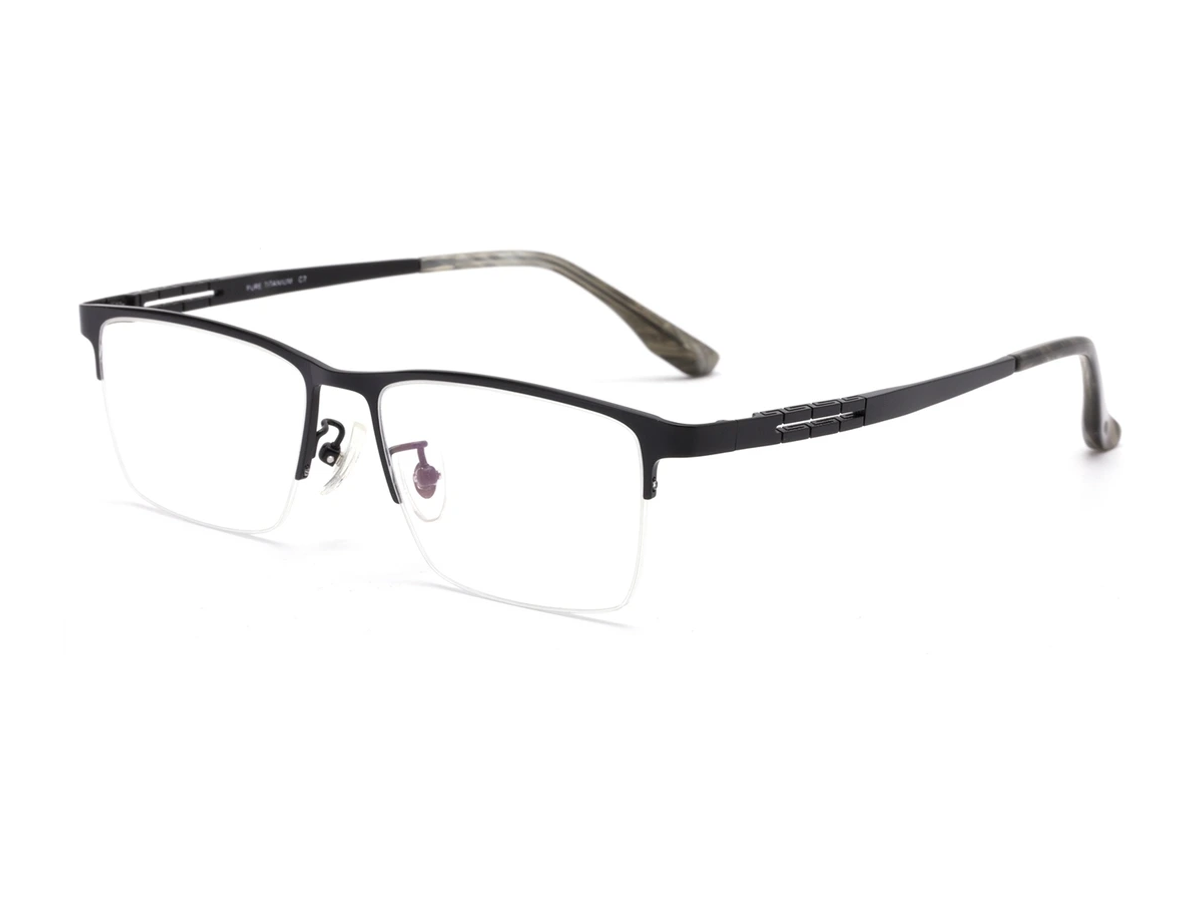
Titanium eyewear brands use the material in different ways: a minimal rimless structure, a decorated temple, a mixed-material frame or a coordinated color system. For a buyer developing a collection, those differences are more useful than an unsupported “best brand” ranking.
This guide covers Blackfin, CHARMANT, LINDBERG, MASAHIROMARUYAMA, MASUNAGA, Matsuda, OVVO, Prodesign, Silhouette and STEPPER. Each has an official source documenting titanium use. The brands below are presented for reference rather than ranked from best to worst; entries are alphabetical.
How the brands were selected
The selection requires a publicly documented titanium product, collection or material program, plus a useful question for eyewear development. It includes optical frames and a sunglasses example. “Titanium eyewear” does not mean every part of every featured frame is pure titanium.
Sources were checked in September 2026. Some examples are earlier designs still documented by the brand, not new 2026 releases. Product availability varies; this is not a stock list, retail buying recommendation or directory of factories accepting OEM orders.
Official descriptions establish what a brand says about its product. They are not independent performance tests. The OEM takeaways are our editorial analysis, not claims about access to those brands’ factories, confidential processes or commercial relationships. Titanium Frames does not claim to manufacture for any brand listed here.
The header image is our own catalog model T2015, not a featured brand’s product. No third-party product photography or logos are reproduced.
A quick reference by design question
| Brand | Design question |
|---|---|
| Blackfin | Material origin versus production location |
| CHARMANT | Different materials by component |
| LINDBERG | Hinges and color combinations |
| Masahiro Maruyama | Intentional asymmetry |
| MASUNAGA | Mixed-metal specification |
| Matsuda | Detail placement on rimless frames |
| OVVO | Accurate material terminology |
| Prodesign | Finish and contact-part details |
| Silhouette | Reduced-component construction |
| STEPPER | Fit-led product planning |
Blackfin — separate material origin from production location
Blackfin’s titanium page describes sourcing titanium from Japan and transforming the sheets into frames in Italy. It also describes beta-titanium components and its own temple-tip adjustment system. These are attributed descriptions of Blackfin’s program, not general specifications for titanium frames.
OEM takeaway: record raw-material origin and finished-frame manufacturing location separately. A request for “Japanese titanium” does not specify the frame’s design, alloy documentation or assembly location. Ask which component the origin claim covers and what evidence supports it. Do not assume a branded adjustment mechanism is available from another supplier.
CHARMANT — assign materials to individual components
The Titanium Perfection Pressure Mount description identifies a titanium bridge and beta-titanium temples. It also explains a one-piece pin associated with CHARMANT’s monoblock construction. The group’s official history places its roots in Sabae, Japan.
OEM takeaway: a component map is more useful than a single “titanium” checkbox. Identify the front or bridge, temples, pins and connection hardware separately. In a rimless brief, include the lens connection as part of the design review. This example does not establish that all Titanium Perfection models use the same construction.
LINDBERG — treat the hinge and color system as design decisions
LINDBERG describes its eyewear as designed and made in Denmark. Its titanium guide documents patented hinges without screws or rivets and color combinations across fronts, temples and temple covers.
OEM takeaway: define the hinge concept before comparing suppliers’ samples. For color planning, specify each component rather than requesting one overall color name. A front-and-temple combination creates separate approval points. Study the design priorities, but do not ask a factory to reproduce a patented hinge or promise the same adjustment behavior without an original, reviewed design.
MASAHIROMARUYAMA — make intentional differences measurable
The official MM-0036 product page describes the brand’s asymmetric design approach and the 2sides collection’s reversed front/back concept. The specifications name pure titanium for the frame, beta titanium and acetate for the temples, and production in Japan.
OEM takeaway: an asymmetric design needs a drawing that distinguishes intentional differences from defects. Mark left and right features, orientation and the approved reference view. Otherwise a general requirement such as “check symmetry” could conflict with the design itself. The material list also shows why a pure-titanium frame description should not be expanded into an all-components claim.
MASUNAGA — document a mixed-metal design precisely
MASUNAGA’s Edition 120 RADIO CITY page identifies a round model with a titanium front and titanium plus K18 gold temples. It describes joining the two metals. This is a specific anniversary design, not a description of every MASUNAGA frame or an ordinary wholesale material combination.
OEM takeaway: when a reference combines metals, identify which areas use each material and whether a visual accent is structural or decorative. Do not replace a documented gold component with a gold-colored finish in the specification and treat them as equivalent. A simpler original design may meet the visual brief without reproducing the reference’s material combination.
Matsuda — examine where decorative detail sits
Matsuda’s M3105-E sunglasses page documents a round rimless construction in titanium, beta-titanium temples and engraved details along the temples. The product is listed as made in Japan. The page supplies a design reference; it does not establish current stock or an independently tested durability advantage.
OEM takeaway: “rimless” does not fully describe a frame’s appearance. Temple surfaces and the bridge can carry much of its visual identity. For an original design, specify the location and extent of decorative work and review those details on a sample. Do not infer engraving depth, tooling or tolerances from photographs.
OVVO — keep a composite distinct from pure titanium
OVVO’s technology page identifies its Surgical Steel & Titanium collection and describes the material as a composite. That is a different description from commercially pure titanium. The brand also presents several other material families, so one collection name should not be applied across its entire range.
OEM takeaway: preserve the supplier’s exact material terminology until it has been clarified. A trade name is not a complete alloy specification, and the presence of titanium is not evidence that the product is pure titanium. Ask for the component composition and the basis of any performance claim. This guide does not repeat OVVO’s comparative strength or life-span claims as verified test results.
Prodesign — include small contact parts in the brief
The Prodesign PREMIUM product page sits within its Danish Heritage collection. It describes titanium construction, matte galvanic finishes and several silhouettes. The displayed model’s details also specify a full rim and titanium nose pads.
OEM takeaway: a material brief should reach beyond the front and temples. Nose pads, branding placement and finish references need their own approval criteria. If you want a matte metallic appearance, provide an approved visual reference and ask which finish route is feasible. Prodesign’s listed finish options are not a statement of Titanium Frames’ available processes.
Silhouette — reduced hardware changes the development questions
Silhouette’s Titan Minimal Art retrospective describes its rimless design without conventional screws or hinges. Its anniversary account identifies the titanium construction and Austrian design context. Those accounts describe the design’s history; their anniversary references should not be mistaken for a 2026 launch.
OEM takeaway: removing familiar components does not remove the need for a detailed specification. It changes the questions: how are lenses retained, where does movement occur, and how is fit adjusted? Define those functions for your own project. A minimalist appearance is not evidence that a frame is simple to develop or interchangeable with another rimless system.
STEPPER — begin with fit, not only the material label
STEPPER’s official brand page describes a fit-led approach rooted in Hans Stepper’s optical background. It lists titanium alongside TX5, TX3 and stainless steel in its material range and distinguishes different fit families. This supports inclusion as a brand using titanium, not a claim that every STEPPER frame is titanium.
OEM takeaway: include the intended fit in the first brief rather than selecting a material and leaving fit until later. State known bridge, temple and overall dimensions, and use a reference sample when available. Ask how the sample will be reviewed for the target wearer; a material label alone cannot define that requirement.
Turn brand research into an original OEM brief
The common lesson is not “copy the most expensive frame.” It is to convert a reference into a list of requirements you can discuss and verify.
Start with the feature that matters to your collection:
- A light visual profile: define rim type, dimensions and the intended silhouette. Compare sample weights on the same basis rather than borrowing a brand’s marketing figure.
- A particular movement or adjustment: describe the function you need. Ask for a feasible original construction, not a replica of a protected mechanism.
- A distinctive surface: separate the color, texture, decorative placement and material requirements. Review a physical finish reference where possible.
- A mixed-material frame: create a component list. Keep titanium, beta titanium, polymers, other metals and finishes distinct.
- Several variants: identify which parts change between versions before requesting MOQ and pricing.
Our titanium versus stainless steel comparison explains why a material name does not predict the complete frame’s performance. For current catalog references rather than third-party brand examples, browse our titanium eyeglass frames. The header image’s T2015 product page provides its own catalog specifications; it is not presented as equivalent to any featured design.
Keep a reference-to-requirement record
For each reference, save the official URL, model and date viewed. Then write down the feature you want to discuss in your own words. Separate the brand’s documented description from what you can see in a photograph and from what remains unknown.
For example, LINDBERG’s documented component color choices can prompt a front, temple and tip color schedule for your own design. They do not specify a supplier’s coloring process. Matsuda’s documented temple decoration can prompt a marked location for original artwork, not a request to copy its motif or an inferred engraving depth.
Turn that observation into a supplier question: which original construction, material and finish could meet the requirement? Record the proposed dimensions, component references and sample approval points. A visual reference starts the conversation; the supplier’s confirmed proposal becomes the basis for the quotation.
Keep fit requirements separate from appearance. If a reference looks light or flexible, request a measured sample and agreed performance evidence rather than borrowing the brand’s claims. Our project brief guide helps organize those inputs without requiring a complete engineering drawing at the first inquiry.
Frequently asked questions
Which titanium eyewear brand is best?
This guide does not establish a best brand. A defensible comparison would need stated criteria and comparable evidence. Use these examples to identify design priorities, then assess the actual models relevant to your project.
Are all ten brands selling pure-titanium frames?
Not as a blanket claim. The sources include titanium, beta-titanium components, mixed-metal designs and a steel/titanium composite. Check the specific model and component description.
Is this a list of OEM suppliers?
No. A branded eyewear collection does not prove that the company accepts third-party OEM projects. For supplier selection, use our guide to finding an eyewear manufacturer in China and verify the proposed supplier’s actual role.
Can I send a branded frame as a reference?
You can identify the fit or construction question you want to discuss, but do not request copied logos, protected mechanisms or a replica. Provide your own design direction and clarify which requirements are essential. Feasibility review is not permission to reproduce another brand’s product.
Discuss your own titanium collection
For a supplier-focused comparison, read our titanium eyeglass frame manufacturers and suppliers guide. It separates sourcing research from the brand design references above; a brand collection alone does not prove third-party OEM availability.
You do not need a complete engineering drawing to start a conversation. Send your original design idea, reference photo or sample, known specifications, target quantity and target price if available.
Our custom eyewear development process explains the review stages. Contact us to discuss suitable options, whether you are evaluating an existing style, private-label changes or a new OEM project. Materials, samples, customization and commercial terms remain subject to confirmation.