
Screwless eyeglass frames use a connection that holds the temple to the frame front without a conventional hinge screw. The term describes a design choice, not a material or a durability rating. Different systems can have different parts, movement and service requirements. Before comparing wholesale prices, ask which mechanism the supplier offers and what information comes with the sample.
For optical retailers and private-label buyers, the useful question is how that particular frame will be supplied, checked and supported. This guide gives you a brief for that conversation.
Confirm what the supplier means by screwless
Start at the connection between the front and the temple. Ask for close-up views with the temple open and closed, along with the supplier’s explanation of how the parts stay connected.
A screw head hidden beneath a cover does not establish a screwless mechanism. Likewise, a frame may have a screwless temple connection while using screws elsewhere. Specify the scope of any screw-free claim you plan to use in a product listing.
Three other terms need separate questions:
- Spring hinge: ask about its movement and return behavior. This describes a function, while screwless describes how the connection is retained.
- Hingeless: ask whether the temple folds through a joint at all and how the frame is stored or adjusted.
- Rimless: this describes the lens perimeter and mounting, covered in our rimless frame guide. It does not identify the temple connection.
Keep the supplier’s model reference with these descriptions. Labels alone will not tell you whether two frames use interchangeable parts.
Documented designs show why the mechanism matters
LINDBERG’s official heritage account describes a screwless spiral hinge formed using titanium. In a different material approach, Marcolin’s official account of ic! berlin describes cold-rolled stainless steel frames combined with a patented screwless hinge.
These examples show why you should identify both material and connection design. They do not establish the structure, performance or repair method of a frame offered by another supplier.
For an OEM brief, describe the function you want: folding behavior, appearance, fit requirements and service expectations. Ask the supplier to propose a design it can legitimately supply. A branded reference can help explain a preference, but it is not a specification for reproducing that brand’s mechanism.
Request a specification for the complete connection
Ask which parts form the hinge and how it joins the front and temple. Request the relevant component materials, part identifiers and assembly information. Clarify whether the hinge is supplied as a separate component or only as part of a completed frame.
For a new project, agree on the movement the design must provide. Ask the supplier to explain the intended opening range, any stop, and the adjustment method. Avoid forcing a sample beyond its stated range to see whether it bends back.
Keep size requirements in the same brief. A hinge description does not replace lens, bridge, temple and overall-width measurements. The frame sizes guide explains which dimensions to request separately.
Use a close-up to ask better questions
The image below shows a visible screw in the connection on our published model 22825. It is included as a comparison reference, not as a screwless product example.
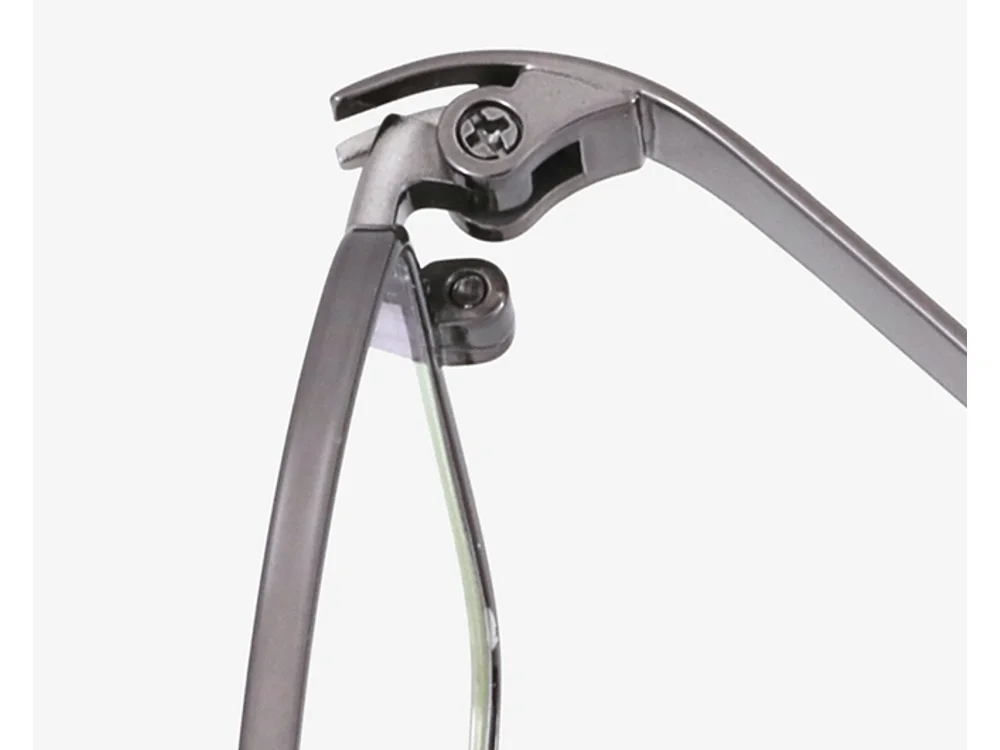
A clear photograph can help identify questions about the delivered assembly. It cannot confirm wear resistance, material grade or serviceability. Request those details from the supplier rather than inferring them from the finish or shape.
Review the sample and the supporting evidence
Check the sample against its own specification. Record the exact model, size, finish and revision, then review both left and right connections. A practical initial review can cover:
- Whether the delivered mechanism matches the agreed description and images.
- Opening and closing movement within the supplier’s stated range.
- Any visible separation, unintended contact or noticeable side-to-side play to discuss with the supplier.
- The condition of contact areas and the surrounding finish.
- Availability of the promised assembly, adjustment and service instructions.
This is a sample-review checklist, not a durability test or a substitute for agreed acceptance criteria. If repeated opening and closing, retention or other performance claims matter to your order, request the relevant test method and results for the selected design. Agree on conditions and limits before production; do not borrow a cycle count from another product’s advertisement.
Our frame quality-control guide covers broader inspection planning. Keep any hinge-specific requirements with the approved sample and order specification.
Check service access before you order
A screwless connection removes the need to tighten a conventional screw at that joint. That alone does not establish that the whole frame needs no maintenance or that a damaged part is easy to replace.
Ask who can adjust or service the selected model, which tools are required, and what your retail team should do if a temple separates or feels loose. Get written handling instructions instead of relying on a generic snap-back demonstration.
Request part numbers and ordering terms for replaceable components. Clarify whether a repair uses a small fitting, a complete temple or a replacement frame. Ask how long parts are expected to remain available and how a later component revision will be identified.
These details affect the purchasing decision. Compare the initial quote alongside sample costs, any required tools, spare parts and the agreed process for resolving defects. A lower frame price does not answer the service questions.
Keep private-label changes separate from hinge development
For an existing frame, ask which sizes, finishes and branding options are available. Confirm a proposed logo location on a sample, especially near moving or contacting parts.
For a new connection design, request a separate feasibility review. Clarify development scope, ownership of drawings or tooling where applicable, sample approvals and the proposed verification work. Obtain the terms for that project rather than assuming they match an existing-style order.
Browse our frame catalog for current model references. If you are evaluating a screwless design, send the reference and requirements so we can discuss feasibility and confirm available options. Include your quantity, target market and service expectations; a product link or photo can start the discussion.
Frequently asked questions
Are screwless frames always titanium?
No. Official brand examples include titanium and stainless steel approaches. Request materials for the selected model and its components separately.
Are screwless frames maintenance-free?
That claim needs model-specific support. Ask for the supplier’s care, adjustment and service instructions, including which parts can be replaced.
Can I repair a screwless hinge with a standard glasses kit?
Confirm the procedure for the exact model. A kit intended for conventional screws may not contain the parts or tools needed for that connection. Follow the manufacturer’s service instructions.
Can a conventional frame be converted to screwless?
Treat that as a design and compatibility question for the supplier. Do not assume a replacement hinge will fit the existing front and temples. Request a feasibility review before modifying a frame or approving a production change.